
There is a lot to take in when you play Minecraft for the first time. You are thrown into a massive world. While there are no step-by-step missions, there are a variety of resources and places to find. This world is full of trees, animals, caves, villages, hostile mobs, crafting recipes, and changing weather. Night can also arrive faster than new players expect.
Luckily, you do not need to learn everything at once. Your first goal in Survival Mode is to collect enough resources to make tools, find food, and create a safe shelter before the sun sets. With these goals achieved, the rest of the game becomes easier to understand.
This Minecraft beginner guide covers 15 essential tips to help you avoid common pitfalls and survive and explore the world more confidently. The advice is general enough to apply to most versions of Minecraft, but controls may vary between console, Android, and PC versions of the game.
If you want to see how Minecraft and Roblox stack up against one another, check out our detailed Minecraft vs Roblox comparison covering building, exploration, multiplayer, and progression.
Harvest Wood
The first resource to harvest in most beginner Survival worlds is wood. Break some logs with your hands and begin to collect wood. For now, use your inventory to turn these logs into planks. Once you make an axe, gathering additional wood becomes faster.
Wood is your starting material for early-game items. With wood, you can make planks, sticks, tools, doors, chests, beds, and more. You can even use it to build a quick shelter.
Some tree types have planks that are colored differently. However, any regular wood variety can be used for your basic early-game needs, so it is better to use the wood closest to your spawn rather than travelling far away for the color you want.
Craft a Crafting Table
Crafting tables are made with four planks, and your inventory has a small 2×2 crafting grid. Many recipes require the 3×3 grid that you get from a crafting table.
To make one, place four wood planks in the 2×2 crafting grid. Place a plank in each of the four squares, then carry the table with you until you find your building spot.
Crafting tables allow you to make tools, chests, campfires, and many other useful items. The official Minecraft crafting guide also explains how the crafting grid and recipe book work.
Upgrade From Wooden Tools to Stone Tools
Mine some stone to replace your wooden tools because wooden tools break quickly. You can mine stone by using a wooden pickaxe on exposed stone or by digging carefully into the side of a hill.
A stone pickaxe should be one of your first upgrades because it allows you to mine important early resources. A stone axe gathers wood faster and lasts longer than a wooden axe, while a stone sword is stronger and more durable than a wooden sword. A shovel helps you collect dirt, sand, and gravel, but it is less urgent if resources are limited.
There is no reason to make several copies of every wooden tool. Instead, make stone tools when you have the ability to do so. You can keep using wooden tools until they break or use them as a furnace fuel source.
Find Food Before Travelling Far
Food is essential in Survival Mode because many activities reduce your hunger level. When your hunger is low, your ability to recover health becomes limited, and starvation can become dangerous depending on the difficulty setting.
Take time to gather food near your spawn before travelling too far. Animals, apples, berries, and food found near villages and farms can provide early supplies. Some raw foods can be eaten, but cooked food usually restores more hunger and is better to carry once you have a furnace.
Keep a few food items easily accessible in your hotbar because you never know when you will need them.
Build a Simple Shelter
One of the biggest beginner mistakes is staying outside while the sun sets. Hostile mobs become a greater threat in dark areas, and a beginner with weak gear can quickly become surrounded.
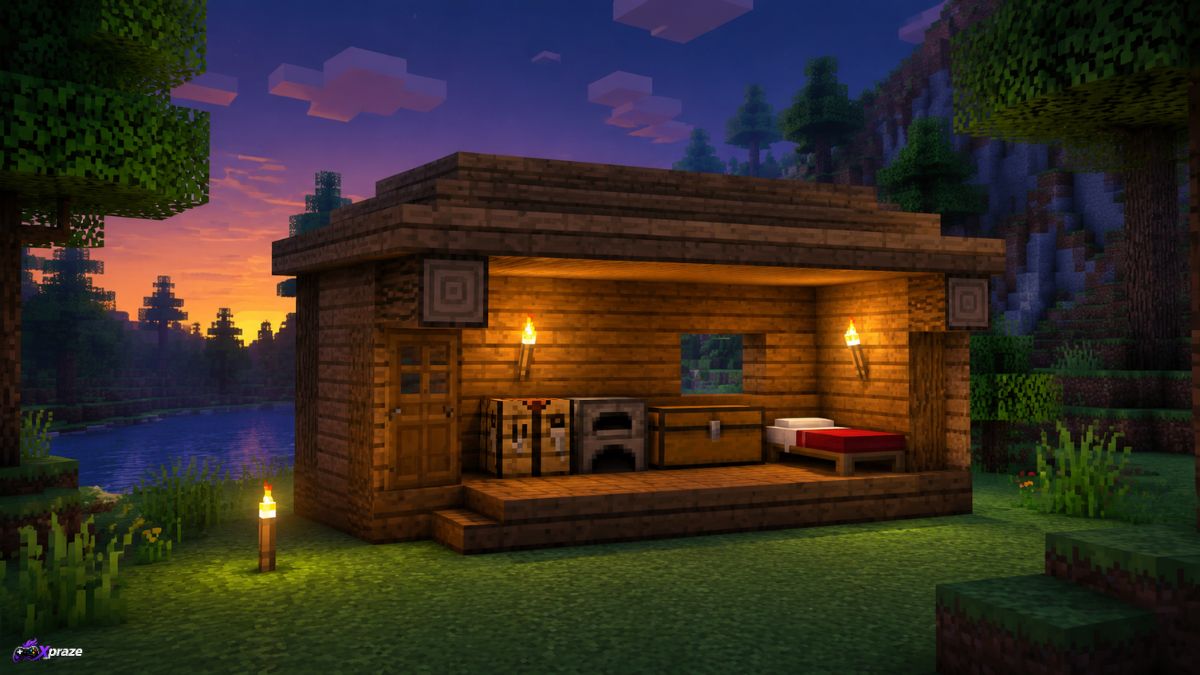
You only need a quick shelter as a safe place for the night. A dirt or wooden structure, a room inside a hill with walls and a roof, or another enclosed space is good enough. The purpose of this shelter is to survive the night, not to make an amazing structure.
Place your crafting table inside and leave enough room for a furnace, chest, and bed. Light the shelter with torches and add a door. Do not leave large open gaps through which hostile mobs can reach you.
Make a Bed
Making a bed is one of the first things you should do because it is one of the most useful early-game items. Using a bed lets you skip the night when sleeping conditions are safe and sets your respawn point in the Overworld.
A bed is made with three matching wool blocks and three wood planks. You can collect wool by using shears on sheep once you have enough iron, obtain wool when sheep are killed, or find beds in some villages.
Place the bed inside your shelter and interact with it. When the spawn point is successfully set, the game displays a message. If you later break or move the bed, place it again and interact with it to set a new respawn point. Otherwise, you may return to the world spawn when you die.
Bring Plenty of Torches
Darkness makes it difficult to navigate and see previously explored paths. It also creates suitable areas where many hostile mobs can spawn. Bring plenty of torches to light your path and reduce dark spawning spaces.
Torches can be crafted with a stick and either coal or charcoal. If you cannot find coal, smelt a log in a furnace to create charcoal, then combine the charcoal with a stick.
Make sure to light the caves you explore. Players often place torches on the same side of a tunnel, but you should still pay attention to their positions so you know which direction leads toward the exit.
Use the Recipe Book
The number of recipes in Minecraft is far too high for a new player to memorize, but the recipe book helps display unlocked recipes and the supplies they require.
It can be accessed from your inventory or the crafting table. As you collect relevant materials, more recipes become available. Depending on your edition and interface, you may be able to display only items you can currently craft.
When in doubt, use the recipe book. You will eventually memorize common recipes for sticks, tools, torches, chests, furnaces, and beds.
Build a Furnace Early
A furnace lets you smelt ores and cook food. It is a vital early-game craft for progression. To create a furnace, place eight cobblestone blocks around the outside of the crafting table’s 3×3 grid and leave the center empty.
Place your furnace next to your crafting table and chest. It needs an item to process and a fuel source. Charcoal and coal are convenient fuels, but several wood-based items can also be used.
Iron should become an early priority because it allows you to craft stronger tools, armor, buckets, shields, shears, and many other useful items.
Never Dig Straight Down
Mining directly below your feet is generally a bad idea. There could be hostile mobs, caves, deep drops, lava pools, and other dangers below you.
To mine safely, stand to one side and mine blocks diagonally or create a staircase. This lets you see what is below you and gives you an exit path.
The same caution applies when mining upward. Avoid standing directly below the block you are going to break because gravel, sand, lava, or enemies may be above it.
Organize Your Inventory and Storage
Stone, dirt, wood, food, tools, ores, seeds, and mob drops can quickly fill your inventory. Spending a little time on organization can help when you need to act quickly in combat, as important items will not be buried among random blocks.
Keep your most important tools, weapons, food, torches, and building blocks in specific hotbar slots. The exact order is your choice; using a consistent system is what matters.
Your base also offers storage advantages. Valuable ores, spare food, drops, and tools are safer in a chest at your base than in your inventory during a dangerous cave expedition.
Prepare Before Entering Caves
Caves contain useful resources, but they also have darkness, drops, confusing paths, and dangerous mobs. A quick look near the entrance is very different from a deep exploration trip.
You should carry food, torches, a pickaxe, and a weapon. Bring some blocks to fill holes or create barriers. Carrying spare wood is also a good idea because you can turn it into sticks, a crafting table, or other useful supplies.
Armor, a shield, and better gear provide useful protection once you can craft them. You do not need to enter a dangerous cave before you are prepared. If enemies are in a difficult position, improve your surroundings or back away instead of charging forward.
Record Your Base Location
Minecraft worlds are extremely large, and forests, plains, and caves can all look similar after some time. Make sure you know your way back before exploring too far.
If coordinates are available in your edition or world settings, write down your base’s X, Y, and Z coordinates. You can take a screenshot or make a quick note on your phone. A standard compass points toward the world spawn instead of your bed, so understand where it will lead before relying on it.
For the first few days, keep exploration loops short and close to your base. This will help you become familiar with the surrounding rivers, hills, valleys, villages, and cave systems.
Treat Death as a Lesson
Most new Minecraft players die. You have not ruined your world if one of those deaths was caused by a creeper, a skeleton knocking you from a ledge, or risky mining that dropped you into lava.
Under the normal game rules, the items you were carrying usually drop at the location where you died. According to Minecraft’s official guide on spawning and dying, dropped inventory has a five-minute recovery timer while the area containing it is loaded. Items can also be destroyed by hazards such as fire or lava.
Before rushing back to collect your items, bring food and basic equipment if you can. Approach the location carefully, remember how you got there, and avoid making the same mistake twice.
Do Not Try to Learn Everything at Once
Minecraft includes enchantments, brewing, redstone systems, automated farms, rare structures, multiple dimensions, trading, and many advanced building techniques. You do not need to learn all of this during your first session.
First, set some easy goals such as gathering basic tools, finding food, and building a simple shelter to help you survive the night. You can then search for iron, build a farm, upgrade your shelter, or explore a nearby cave.
Minecraft offers many challenges, and the best part is that your direction is entirely up to you. You can focus on survival, building, exploration, multiplayer, or another goal. There is no single correct path.
If you want to play with friends, check out our list of the best multiplayer Android games.
Minecraft Beginner Guide: What to Do on the First Day
An easy-to-follow beginner plan removes much of the early-game confusion. Start by collecting several logs and turning them into planks. Build a crafting table, craft some sticks, and make a wooden pickaxe. Use your pickaxe to gather cobblestone, then replace your main tools with stone versions.
After that, collect food and gather some more wood in the nearby area so that you do not lose your starting point. If you see sheep, collect the wool needed for a bed. While doing all of this, make sure to build a safe shelter before night.
Place your crafting table, furnace, and chest inside the shelter. Add torches if you have them. If you have a bed, use it to set your respawn point and sleep. Cook food and organize your supplies for the next day. Do not worry about crafting iron armor, mining diamonds, or building a farm before the first sunset. Having food, stone tools, and a safe shelter is already a successful start.
Survival Mode vs Creative Mode for Beginners
Neither Survival Mode nor Creative Mode is automatically better for every beginner. If you want to learn gathering, crafting, hunger, health, exploration, and normal progression, Survival Mode is a good choice. It requires you to gather the resources needed for the tools and structures you want.
Creative Mode is more focused on building. It provides unlimited resources, removes most survival pressure, and lets you fly around the world to test ideas. It is useful if you mainly want to practise controls, learn how blocks work, or build without gathering materials.
You can learn the core building mechanics in Creative Mode without affecting your ability to enjoy Survival Mode in a separate world. Likewise, a player can start in Survival and later focus more heavily on building and exploration.
The difficulty you choose will also affect the experience. If Normal feels too difficult while you are learning the controls, you can start on Easy. Peaceful removes most hostile-mob danger, but it also changes the normal Survival challenge. Choose the difficulty that helps you learn without unnecessary frustration.
Common Beginner Mistakes
Many early mistakes happen because of poor planning. Examples include going on a journey unprepared, spending the night in the open, entering a cave without enough light, carrying every valuable item, and forgetting where your base is. Other players use wooden tools for too long or dig straight toward bedrock because they think it is faster.
The answer is to prepare for what you are about to attempt. Store the things you do not need, bring the essentials, and return to your base when important supplies run out. Minecraft rewards exploration, but careful planning usually leads to safer and more consistent progress.
Final Thoughts
Once you understand the core elements of the early game, you can begin enjoying everything Minecraft has to offer. Take your time and do not rush toward advanced goals.
These 15 tips can give you a strong starting foundation, but you are the best judge of what makes an enjoyable world. Learn from your mistakes and take on more challenging goals when you feel ready. For other games that provide strong mobile experiences, check out our guide to the best Android games.
FAQs
1. What should be my top priority in Minecraft Survival Mode?
Start by collecting wood and making a crafting table. Upgrade your main tools to stone, find food, and build a safe shelter before nightfall.
2. What are the keys to surviving my first night in Minecraft?
Build an enclosed shelter with a roof, light it with torches, and avoid unnecessary fights. If you have three matching wool blocks and three planks, craft and use a bed.
3. Should a new player start in Survival or Creative Mode?
Choose Survival to learn gathering, crafting, hunger, and progression. Choose Creative if you mainly want to practise building without survival pressure.
4. Why is it not a good idea to dig straight down?
You cannot see the space below you. You could fall into a deep cave, land near hostile mobs, or drop into lava.
5. How can I avoid getting lost in Minecraft?
Record your base coordinates, keep early routes short, and use clear landmarks. Remember that a standard compass points toward the world spawn, not your bed.

Xpraze is dedicated to helping Android gamers discover the best games, tips, and guides. We publish gaming reviews, guides, news, lists, and comparisons to help players find useful and up-to-date information quickly.